
perikles
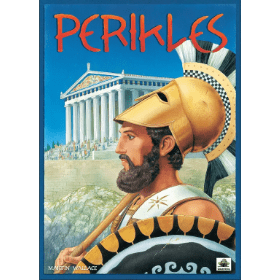 Perikles ialah permainan daripada Martin Wallace. Pemain memainkan peranan sebagai keluarga bangsawan yang ingin menjadi pemimpin satu atau lebih daripada 6 negara kota Yunani purba. Permainan ini berlangsung dalam dua fasa:
Dalam babak pertama, pemain bersaing untuk mengawal kawasan di setiap enam negeri, yang berakhir dengan pilihan raya. Pemain yang memenangi pilihan raya di setiap negeri kemudiannya boleh mengawal tentera negeri tersebut.
Dalam fasa kedua, pemain menggunakan kad untuk menggerakkan tentera mereka bagi menyerang atau mempertahankan salah satu daripada tujuh pertempuran (setiap satu terikat dengan negeri, dan anda tidak boleh menyerang negeri anda sendiri!) yang boleh dimenangi pada pusingan itu.
Mekanik permainannya mudah, dengan elemen yang diambil daripada permainan warga gaya Euro yang lain (terutamanya Struggle of Empires karya Martin Wallace). Apa yang menjadikan Perikles unik ialah penyepaduan lancar fasa kawalan/pengundian kawasan dan fasa ketenteraan.
Bilangan pemain: 3 - 5
masa permainan: 17 mn
Kerumitan: 4 / 5
Main perikles dan 1394 permainan lain atas talian.
Tidak perlu dimuat turun - main terus dari laman web anda.
Dengan rakan-rakan dan beribu-ribu pemain dari seluruh dunia.
Percuma.


Main perikles dan 1394 permainan lain atas talian.
Tidak perlu dimuat turun - main terus dari laman web anda.
Dengan rakan-rakan dan beribu-ribu pemain dari seluruh dunia.
Percuma.
Ringakasan peraturan
Perikles
In Perikles, players represent influential Greek families. Over three epochs, they strive to gain political control in six city-states and lead the armies of these cities to victory in various battles.
Game Objective
Win by accumulating the most Victory Points (VP). Points are awarded at the end of each epoch for won battles (Statue tokens) and at the end of the game for controlling city-states.
Game Flow
The game is played over three epochs. Each epoch consists of two main phases: the Political Phase and the War Phase.
1. Political Phase (Influence & Control)
During this phase, players place their influence cubes to take leadership of the cities.
- Selecting Influence Tiles: Players take turns picking tiles that indicate which cities they can place cubes in.
- Placing Cubes: Cubes are placed in the six cities (Athens, Sparta, etc.).
- Elections: In each city, the player with the most cubes is checked.
- The player with the most cubes becomes the Leader of the city for that round.
- They receive the city's two Army Tiles (Land and Sea forces).
- Specific tie-breaking rules apply if necessary.
- Ostraka (Exile): Players can attempt to remove opposing cubes from cities to secure a majority.
2. War Phase (Battles & Strategy)
The leaders of the cities now deploy their armies to launch attacks against Persia or other Greek locations on the board.
- Deploying Armies: Players place their Army Tiles face-down on available locations. Battles are categorized as Land or Sea combat.
- Resolving Battles: Tiles are revealed. Combat is resolved by comparing combat strength (Strength values on tiles + a die roll).
- Attacker vs. Defender: The attacker must overcome the location's defense or the opposing armies present.
- Casualties: Defeated units are removed from the board.
- Rewards: The winner of a battle receives a Statue token, which provides VP at the end of the epoch.
Actions & Decision Factors
Influence Tile Categories
Tiles offer various tactical options:
- City Symbols: Allow placing 1 or 2 cubes in the corresponding city.
- Event Tiles:
- Plague: Reduces the number of cubes in a chosen city for all players.
- Treachery: Allows weakening or manipulating an army in battle.
- Persian Fleet: Can be used in sea battles to influence the outcome.
Military Units
- Hoplites (Land): Used for land battles in the regions.
- Triremes (Sea): Used for naval battles to secure control over the seas.
- Sparta Special Rule: Spartan land units are exceptionally strong in combat but have less political flexibility.
End of Game & Scoring
Final scoring takes place after the third epoch:
- Statue Points: Sum of points from all three epochs.
- City Control: Players holding leadership in a city at the end of the third epoch receive bonus VP based on the city's value.
- Remaining Influence: Minor points for leftover resources.
The player with the most total Victory Points is the winner.